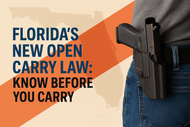
Florida’s New Open-Carry Law: What’s Changed — and How to Carry Safely
Posted by Civil Defense Armory on Oct 17th 2025
Introduction
Florida has just entered a new era in firearm law. On September 10, 2025, a three-judge panel of the First District Court of Appeal struck down Florida’s decades-old open-carry ban (statute 790.053), declaring it unconstitutional. Wikipedia+3Ogletree+3WUFT+3
The effect of that ruling was made statewide by Florida’s Attorney General, who declared that open carry is now the “law of the state.” WUFT+2Politico+2
As of September 25, 2025, legal gun owners in Florida may openly carry a firearm, under certain restrictions. CBS News+2MyNews 13+2
But “open carry allowed” doesn’t mean “carry anywhere, anyway.” The change comes with legal nuance, responsibility, and risks. In this post, I’ll explain what the new law means (and doesn’t mean), and share best practices for carrying openly in a safe, responsible, and legally defensible way.
What the New Law Means (and Doesn’t Mean)
What Changed
-
Ban Overturned
The prior Florida law, in effect since 1987, had criminalized openly carrying a firearm (except for limited displays). That law was struck down as inconsistent with the constitutional right to bear arms. Ogletree+2CBS News+2 -
Statewide Effect
Although the court decision was from the First District (which covers a swath of northern Florida), Attorney General James Uthmeier declared the ruling operative statewide and directed prosecutors and law enforcement not to enforce the old ban. WUFT+2Ogletree+2 -
Open Carry Without Permit (for those eligible)
The decision allows those legally permitted to possess firearms to carry them openly (i.e., not concealed). Florida had already adopted permitless or “constitutional carry” for concealed carry in 2023. Wikipedia+2Wikipedia+2 -
Private Property Exclusions & Trespass
Just because open carry is allowed doesn’t mean every place will accept it. Private property owners (such as stores, restaurants, theme parks) retain the right to prohibit firearms on their premises. If you refuse to leave when asked, you may face "armed trespass" charges (a third-degree felony). Ogletree+3WUFT+3CBS News+3 -
Continued Restrictions in Certain Locations
Many of the same “sensitive places” that were off limits under concealed-carry or other laws remain off limits under open carry. For example:-
Schools, colleges, school administration buildings
-
Government buildings, courthouses
-
Bars or portions of restaurants primarily devoted to alcohol
-
Polling places
-
Jails, prisons, law enforcement facilities
-
Areas restricted by federal law (airports, certain federal buildings)
Opening a gun in a location where firearms are prohibited can lead to criminal liability. CBS News+2MyNews 13+2
-
-
No Wild West Rule
The court opinion and the AG’s guidance clarify that while open carry is now allowed, you cannot brandish in a threatening or angry manner, or use the firearm in a way that violates other laws (e.g., assault, disorderly conduct, menacing). MyNews 13+2CBS News+2 -
Uncertainty and Confusion
Because the statutes haven’t yet been fully revised, and because local officials and law enforcement are still adapting, there's a period of legal ambiguity. Some sheriffs and police agencies caution gun owners to exercise restraint, stay informed, and err on the side of legal caution. The Guardian+2MyNews 13+2
Best Practices for Open Carry in Florida
Carrying openly imposes a higher level of visibility and scrutiny. To minimize risks and stay within the law, consider the following safe-carry practices:
1. Get Quality Training
Even if you already carry concealed, open carry introduces new challenges (e.g. drawing in public, holster considerations, threat assessment). Seek training from certified firearm instructors who emphasize de-escalation, situational awareness, and legal rules of force.
2. Use a Proper Holster or Open-carry Rig
-
The firearm should sit securely: use a holster that retains the gun (partial retention is acceptable) to prevent it from shifting, falling, or being grabbed.
-
Make sure you can cover the trigger guard fully.
-
Opt for a holster that provides good concealment of unnecessary parts (unless fully exposed by design), to limit unnecessary attention.
-
Practice drawing and reholstering safely, especially in public settings and under stress.
3. Be Intentional About How You Carry
Open carry does not mean you walk around with your gun dangling in plain view at all times. Some guidance to consider:
-
Don’t “brandish” — avoid gestures or movements that might be perceived as threatening (e.g. sweeping motions, waving).
-
Keep your muzzle pointed in a safe direction.
-
Be aware of your surroundings: avoid crowded or tense environments when possible.
-
If entering a business or private property, observe signage or policy. If told to leave, comply.
-
Minimize fast or suspicious movements; keep control of the firearm at all times.
4. Know Prohibited Locations & Stay Current
Even with open carry legalized, you must avoid carrying where firearms are prohibited. Keep up with state and federal law changes, and always verify a venue’s policy. If in doubt, leave the firearm outside or concealed (if permitted).
5. Communicate When Necessary—but Sparingly
If asked by law enforcement, promptly and respectfully disclose your open carry — “Officers, I am openly carrying a firearm.” Keep your hands visible, comply with instructions, and don’t make sudden movements toward the weapon.
6. Practice Safe Handling Always
-
Always follow the four cardinal rules of firearm safety (treat every gun as loaded; never point at something you are not willing to destroy; keep finger off trigger until ready; be sure of your target and what’s beyond).
-
Regularly inspect and maintain your firearm and holster.
-
Rehearse drawing, scanning, and holstering in different light and environmental conditions.
7. Be Mindful of Public Perception
Open carry is more visible, and that visibility brings public attention. Be mindful of how others may perceive seeing a firearm openly. Conduct yourself with calm, responsibility, and courtesy. Avoid drawing unnecessary attention or initiating confrontations.
8. Use Discretion
Just because something is legally allowed doesn’t always mean it’s wise. In certain crowded settings, large gatherings, or emotionally charged environments, open carry may be more of a liability (e.g. mistaken for a threat). Sometimes concealed carry (if legal) or leaving the firearm secured might be the wiser choice.
Potential Risks & Challenges
-
Misidentification / Alarm
Bystanders or law enforcement might misinterpret open carry as an aggressive act, especially in tense contexts. -
Legal Gaps / Gray Areas
Because the legislature has not yet fully updated statutes, and because different officials may interpret the decision differently, there’s a risk of inconsistent enforcement or legal challenge. -
Trespass / Ejection
Even when open carry is legal, property owners can forbid guns on their premises. Failing to heed a request to leave can lead to criminal charges. -
Escalation Risk
Some critics warn that open carry may increase the chance of confrontational interactions turning violent, especially in heated disputes. Florida Bulldog+1 -
Insurance / Liability
In the event that a shooting occurs, open carry might complicate civil or criminal defense, particularly if there’s a question about how the firearm was carried or displayed.
Conclusion
Florida’s new open-carry regime marks a significant shift. The right to openly carry a firearm is now recognized, but with that right comes responsibility, knowledge, and care.
If you choose to carry openly:
-
Stay educated on evolving laws
-
Use proper equipment and training
-
Respect private property policies
-
Carry in a way that is safe, lawful, and conscientious
One of the core ideals of firearms safety is that it’s not enough simply to have legal rights — the carriage and use of a firearm must always be handled with deliberate caution, restraint, and respect for others.